Manufacturing Issues

Manufacturing Issues

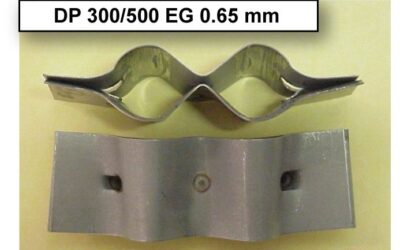
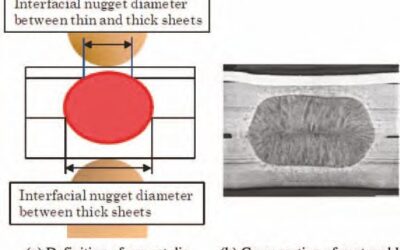
Spot Welding of Three Steel Sheets with Large Thickness Ratios Application of Spot Welding to Hollow Members   Spot Welding of Three Steel Sheets with Large Thickness Ratios Car parts such as side panels are fabricated by spot welding three steel sheets together....
read more
Embrittlement Phenomenon

Embrittlement Phenomenon

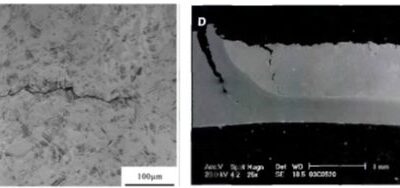
It has been a long-standing challenge to extend the usage of the very high-strength steels in hydrogen-rich environments, given that these steels are prone to Hydrogen Cracking, due to their increased mechanical strength. Hydrogen embrittlement (HE) is known to be a...

read more
Post-Heat Conduction CTS Improvement

Post-Heat Conduction CTS Improvement

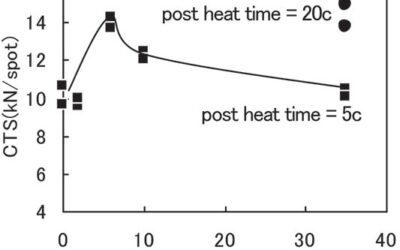
The joint strength in the peeling direction begins to decrease when the Base Metal (BM) strength exceeds 780 MPa. It has been found that the Cross-Tension Strength (CTS) of HSS joints could be improved by using appropriate conditions for post-heat conduction. Unlike...

read more
Spot Welds Fatigue Strength

Spot Welds Fatigue Strength

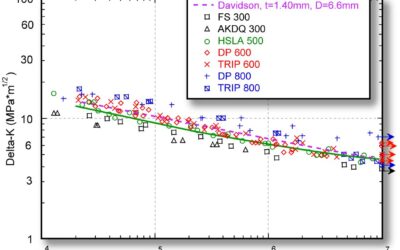
In a comparative studyL-6 of the spot weld fatigue strength of various steels grades, some of which included grades such as 1.33-mm Fully Stabilized (FS) 300/420 (HDGA), 1.35-mm DP 340/600 (HDGA), 1.24-mm TRIP 340/600 (HDGA), and 1.41-mm TRIP 340/600 (HDGA), it was...

read more
Weld Testing and Fracture Modes

Weld Testing and Fracture Modes

Weld-Shear Tension Strength Fracture Modes Peel and chisel testing of resistance spot welds (RSW) in AHSS may produce fracture through the weld during destructive or teardown testing. This type of fracture becomes more common with increasing sheet thickness and BM...

read more
Coating Effects

Coating Effects

One of the methods by which the coatings are applied to the steel sheet surface is through a process called Hot Dipped Galvanizing (HDG). In this process, continuous coils of steel sheet are pulled at a controlled speed through a bath containing molten Zinc (Zn) at ~...

read more
RSW Joint Performance and Testing

RSW Joint Performance and Testing

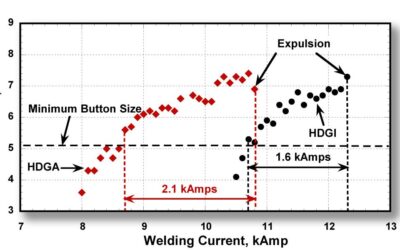
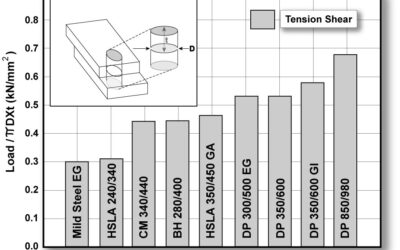
Acceptable weld integrity criteria vary greatly among manufacturers and world regions. Each AHSS user needs to establish their own weld acceptance criteria and the characteristics of AHSS resistance spot welds. AHSS spot weld strength is higher than that of the mild...

read more
AHSS and Electrode Geometry

AHSS and Electrode Geometry

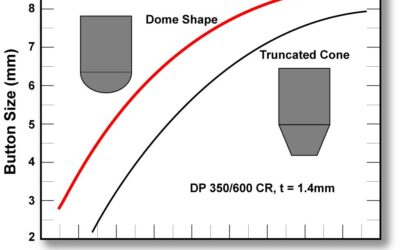
Although there are differences in weld process depending on weld tip material and shape (truncated cone and dome shape), AHSS can be welded with all weld tip shapes and materials. Dome-shaped electrodes ensure buttons even at lower currents due to higher current...

read more
RSW Parameter Guidelines

RSW Parameter Guidelines

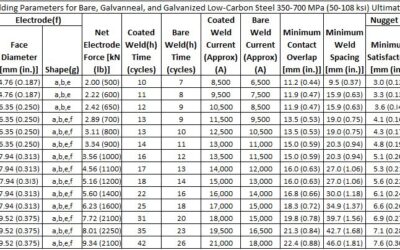
Parameter Guidelines Heat, Material and Thickness Balances Welding Current Mode   Parameter Guidelines In summary, Tables 1 and 2 provide the AWS C1.1 Spot Welding Parameter Guidelines link to Recommended Practices for Resistance Welding. These general guidelines...

read more
RSW of Advanced High-Strength Steels

RSW of Advanced High-Strength Steels

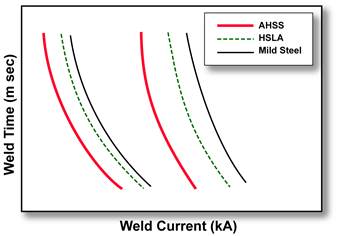
In general, if any type of AHSS [Dual-Phase (DP), Transformation-Induced Plasticity (TRIP), Complex Phase (CP), Ferrite Bainite (FB), or Martensitic (MS)] is used for the first time, the user should take the welding schedules applied to mild steel and then: Increase...

read more