
Advanced High Strength Steels are a common approach that autobody engineers use for applications requiring grades with yield strength exceeding 500 MPa. Steelmakers are increasingly offering alternatives based on High Strength Low Alloy Steel production concepts. This article explores how those steels can be beneficial for automotive applications.
Advanced High Strength Low Alloy (AHSLA) steels represent an extension of conventional cold-rolled HSLA technology into yield strength levels above the traditional 500 MPa limit. Historically, cold-rolled HSLA grades were constrained by the preference toward full recrystallization annealing after cold reduction, resulting in commercially available grades typically limited to roughly 460-550 MPa minimum yield strength.
For higher strengths, automotive manufacturers generally rely on advanced high-strength steels (AHSS) such as dual-phase (DP) and complex-phase (CP) steels. While AHSS provide superior global formability as measured by elongation and strain hardening capability (n-value), the single phase microstructure of HSLA steels has advantages in local formability, including bendability and hole expansion performance. AHSLA steels seek to bridge this gap by achieving significantly higher yield strengths while preserving the favorable weldability, edge stretchability, and local formability characteristics associated with HSLA metallurgy.
How Annealing Strategies and Alloying Raise HSLA Strength
The key metallurgical strategy enabling microalloyed AHSLA steels is the use of annealing temperatures below those required for full recrystallization. As annealing temperature decreases, yield and tensile strength increase while elongation naturally declines, allowing the production of grades such as CR550LA, CR600LA, CR700LA, and beyond. In recovery annealing, microstructural dislocation density and internal stresses are reduced while much of the deformed cold-rolled microstructure is retained, producing the highest strength levels of AHSLA grades, with correspondingly lower elongation. Partial recrystallization annealing employs somewhat higher temperatures that convert a portion of the deformed structure into recrystallized grains, leading to a mixed microstructure and an intermediate balance of strength and ductility.
Microalloying additions such as niobium and molybdenum influence final properties in addition to annealing practice, steel chemistry, cold reduction, and annealing time. Industrial studies demonstrate that these grades can be produced by multiple processing routes, including batch annealing, continuous annealing, and continuous hot-dip galvanizing, with differing microstructural strategies used to achieve similar strength targets.
AHSLA vs. DP and CP Steels: Local and Global Formability
A major advantage of AHSLA steels is their balance of local and global formability. Reported hole expansion ratios (HER) are comparable to, and in some cases exceed, those of dual-phase and complex-phase steels at similar strength levels. Commercial AHSLA products spanning approximately 500 to 1000 MPa yield strength maintain relatively high edge formability despite increasing strength, making them attractive where trimmed edges, pierced holes, or tight bend radii are critical. Direct comparisons between CR550LA and CR590DP show the expected tradeoff: DP steel exhibits greater elongation and strain hardening, while HSLA steel delivers markedly higher yield strength with comparable hole expansion performance. This suggests that AHSLA grades can serve as alternatives to certain AHSS grades when exceptional global formability is unnecessary.
Traditional formability diagrams, which emphasize tensile strength versus elongation, tend to favor AHSS (Figure 1). However, when yield strength is used as the primary design variable, AHSLA steels appear considerably more competitive because they provide high as-delivered strength with acceptable ductility and superior local formability (Figure 2). Expanded formability maps comparing uniform elongation and true fracture strain indicate that AHSLA grades occupy a region of balanced performance, outperforming many DP and CP steels in fracture-limited forming operations.
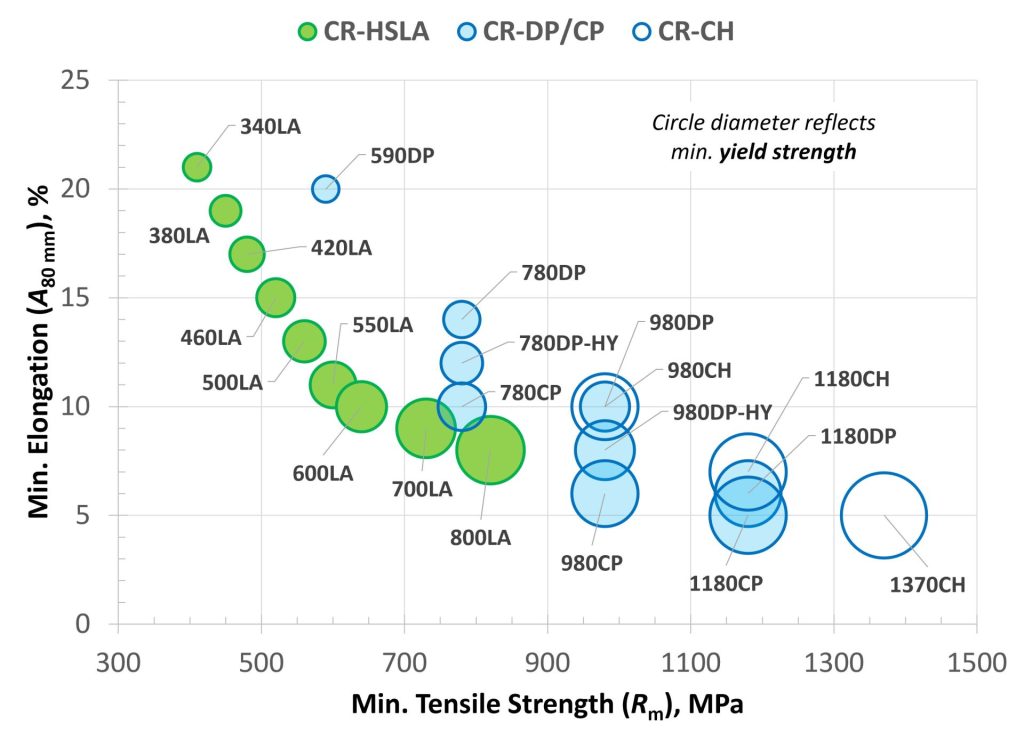
Figure 1: Traditional Global Formability Diagram based on the VDA 239-100 standard (minimum requirements), with the circle diameter proportional to the minimum yield strength of each grade. Also included are proposed “Super HSLA” grades. [1]
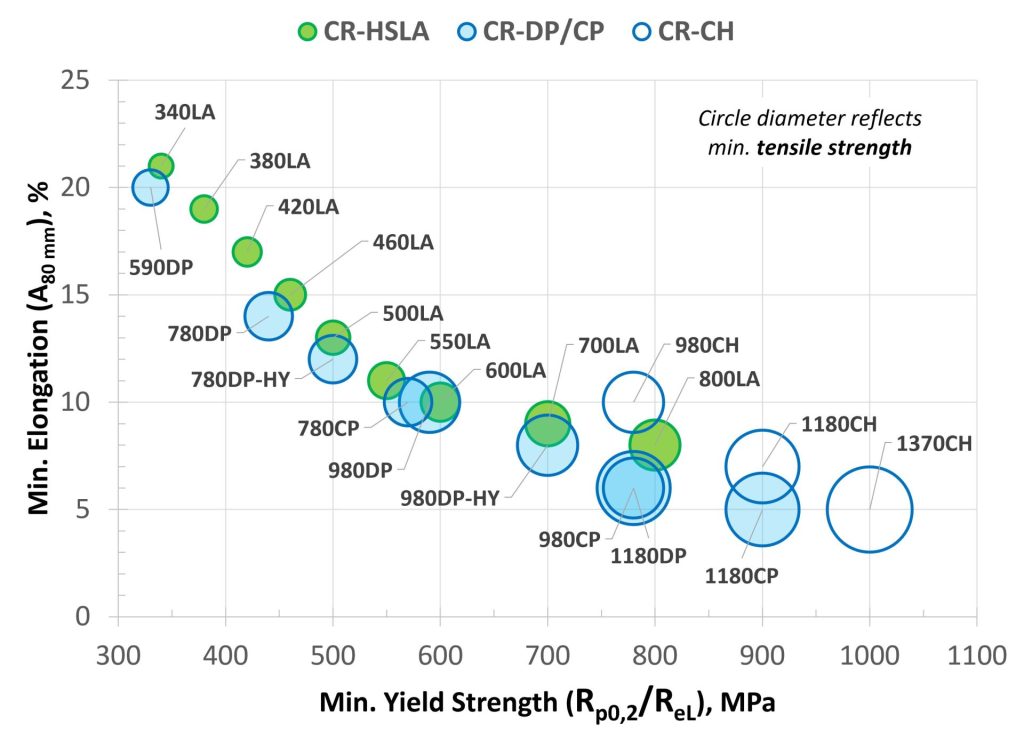
Figure 2: Alternative Global Formability Diagram comparing minimum elongation and minimum yield strength. Here, the circle diameter reflects the minimum tensile strength for each grade. Note that the same data are represented in Figure 1 in the more traditional way (elongation vs tensile strength).
Thin-Slab and EAF Production: Expanding the Supply Base
Beyond performance, AHSLA steels may also broaden the automotive supply base. Low carbon levels, often below about 0.08%, and lower overall alloy content improve castability and make them compatible with both integrated and thin-slab EAF (electric arc furnace) production routes.
Automotive Applications: Roll-Formed Parts, Seating, Bumpers and EV Battery Protection
Minimum yield strength levels above 500 MPa are typically achieved through cold rolling followed by partial recrystallization or recovery annealing. AHSLA steels often exhibit a high yield-to-tensile strength ratio, frequently exceeding 0.9, indicating that high yield strength is already present before forming.
For automotive applications, the combination of high yield strength, low carbon equivalent, good weldability, and limited dependence on work hardening make these grades particularly attractive for roll-formed components, e.g. roof bows or side intrusion protection beams.
Other components that could benefit include those not subjected to the body-in-white (BIW) paint-baking process and therefore do not benefit from bake hardening. These include various automotive seating components (seat tracks, structural members), bumper beams, and electric vehicle battery protection systems. Their high yield-to-tensile strength ratio of AHSLA grades allows strength to remain relatively uniform throughout the component, including low-strain regions that do not benefit from work hardening or bake hardening. Although their suitability for crash-energy-management body-in-white applications relative to established AHSS grades remains under evaluation, AHSLA steels offer a compelling alternative where high yield strength, excellent local formability, manufacturing robustness, and weldability are primary design considerations.
More information about conventional and advanced high-strength low-alloy steels is available here. Thanks to Dr. Brandon Hance and Dr. Daniel Schaeffler for providing this article.
References:
[1] B.M. Hance and H. Mohrbacher, “Optimization of global and local formability properties through Nb microalloying,” Presented at 3rd Automotive Steel International Conference AISTech, 9–12 March 2025, Orlando, Fla., USA, 47-53.
 Dr. Brandon Hance has dedicated more than 30 years to the automotive industry focused on the mechanical and physical metallurgy of high-strength steels. In his most recent role at CBMM North America, he supported customers from material grade development through industrial implementation. Before that he served as Vice President & Head of the Applications Engineering Group at Hyundai Steel Company in South Korea, as well as in prior R&D roles at United States Steel Corporation, AK Steel Corporation, The Timken Company and Novelis. Brandon has a PhD degree in Materials Science from the University of Pittsburgh, an MS degree from the Colorado School of Mines, and a BS degree from the Illinois institute of Technology. He currently volunteers as Secretary of the North American Deep Drawing Research Group (NADDRG) and is the USA Representative to the International Deep Drawing Research Group (IDDRG).

Danny Schaeffler is the Metallurgy and Forming Technical Editor of the AHSS Applications Guidelines available from WorldAutoSteel. He is founder and President of Engineering Quality Solutions (EQS). Danny wrote the monthly “Science of Forming” and “Metal Matters” column for Metalforming Magazine, and provides seminars on sheet metal formability for Auto/Steel Partnership and the Precision Metalforming Association. He has written for Stamping Journal and The Fabricator, and has lectured at FabTech. Danny is passionate about training new and experienced employees at manufacturing companies about how sheet metal properties impact their forming success.